The advertising industry has witnessed dramatic changes over the past two decades. Looking back on your journey as a founder and creative leader, what has been the most significant shift in how brands connect with consumers today?
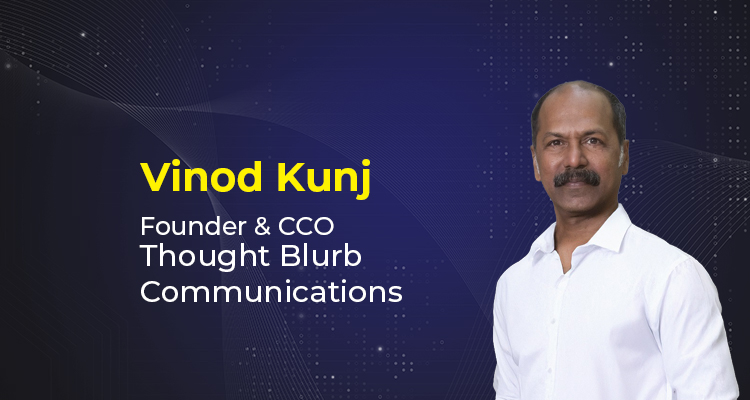
When I started Thought Blurb in 2007, communication was built around what I call appointment viewing. Television had fixed time slots. Newspapers arrived every morning. Magazines came weekly or monthly. Consumers had to be present at a particular time to receive information. Brands knew where consumers would be and when they would be there. The challenge was to create communication compelling enough to hold their attention.
Today, that world has completely changed. We have moved from appointment viewing to mood viewing. We have moved from appointment reading to mood reading.
Consumers no longer wait for content. They curate it. Their feeds are shaped by their interests, emotions, conversations and even the mood they are in at that moment. News doesn’t necessarily come from newspapers anymore. Entertainment doesn’t necessarily come from television. Brand discovery can happen through a social feed, a recommendation, a reel or even an algorithm.
The most significant shift, therefore, is not technological. It is behavioural.
Consumers have moved from listening to brands to deciding which brands deserve their attention.
That has fundamentally changed the role of advertising. Reach alone is no longer enough. Visibility alone is no longer enough. Brands have to earn relevance before they earn attention.
At Thought Blurb, we have always believed that while platforms evolve, human emotions don’t. Technology determines where a message appears. Emotion determines whether it stays with people.
India has over a billion people, hundreds of languages and thousands of cultural nuances. Yet the one language every Indian understands instinctively is emotion. That belief has guided our work for almost two decades, and I believe it has become even more relevant today.
Creativity remains at the heart of effective communication, even as technology and AI reshape the marketing landscape. How can brands strike the right balance between data-driven decisions and human creativity?
I don’t see AI and creativity as competing forces. I see them as complementary.
AI is extraordinarily powerful at reshaping, reorganising, reformulating and recombining existing knowledge. It learns from what humanity has already created and presents it in faster, more efficient and often more accessible ways.
Creativity, on the other hand, creates new knowledge.
Whether it is a visual, a line of copy, a story, a campaign or a completely new way of looking at a problem, creativity is the birth of an idea that did not exist before. AI feeds on creativity. Creativity expands the universe that AI later learns from.
That is a very important distinction.
I don’t believe AI diminishes creativity. If anything, it enhances the way creativity is presented. AI can eliminate repetitive tasks, accelerate execution, shorten production cycles and improve efficiency. It gives creative people more time to think, question, imagine and create.
Data tells us what consumers are watching, buying and clicking.
Creativity tells us why they laugh, cry, remember and care. Those are two very different jobs. The future, in my opinion, is not humans versus AI. It is artificial intelligence working alongside emotional intelligence.
Technology will continue to evolve. Human imagination will continue to lead.
Some campaigns resonate deeply because they reflect authentic cultural insights rather than broad generalizations. How can brands create communication that feels locally relevant while still appealing to a wider audience?
India is often described as one large consumer market. I think that is an oversimplification.
India is not one market.
It is many emotional cultures.
Languages change every few hundred kilometres. Traditions change. Festivals change. Rituals change. The emotional meaning attached to those rituals also changes.
That is why our approach to large brands such as Parle has never been to create one national campaign and merely translate it into different languages.
Translation changes words.
It does not change meaning.
We prefer what I call a horses for courses approach. We begin by identifying the emotional truth that matters most to a particular community and then build communication around that insight.
Our work around festivals such as Bihu, Onam, Chhath, Lohri and Durga Puja follows exactly this philosophy.
A Bihu campaign resonates most deeply in Assam because it draws upon memories, music, traditions and lived experiences that belong to the people there. An Onam story speaks differently to Kerala. A Chhath campaign carries a completely different emotional vocabulary in Bihar and eastern Uttar Pradesh.
Yet all of these stories travel beyond their geography because while cultures differ, emotions don’t.
The real challenge for brands today is identifying the emotional sweet spot, not just region by region, but increasingly community by community and even diaspora by diaspora.
Consumers don’t connect with communication because it is local. They connect with it because it is emotionally true. That is what makes authenticity scalable.
You have worked on numerous brand-building initiatives across diverse industries. Could you share a campaign that presented an unexpected challenge and the key lessons it taught you about strategy, creativity or consumer behaviour?
One campaign that stands out is our recent work for Parle-G.
For years, the brand has been associated with the thought that G stands for Genius. Post-pandemic, we collectively evolved that idea into something deeper; that genius is not only about intelligence in the conventional sense. It is also about emotional intelligence. It is about empathy.
That thinking gave birth to the platform “Jo auron ki khushi mein paaye apni khushi” -the belief that true happiness lies in finding joy in someone else’s happiness.
Over the years, we have expressed this thought through commercials of different durations, from 30 seconds to 40 seconds, one minute and even films lasting over three minutes. Many of them have travelled far beyond advertising and become widely shared because they connected emotionally.
Then came an interesting challenge.
The client asked us whether we could create the same emotional impact in just twenty seconds. That forced us to rethink everything. Instead of trying to compress a longer story, we simplified it.
We removed dialogue completely.
We relied purely on visual storytelling, performance, silence, music and cinematic craft to communicate emotion. Our belief was simple. If the emotion is genuine, words become optional. The result has been deeply satisfying. The campaign has been very well received, and more importantly, it reaffirmed something we have always believed.
Duration does not create emotion. Clarity does.
Consumers rarely remember how long or quick a film was. They remember how it made them feel.
We also consciously chose filmmakers like Martin Prakatt, an highly acclaimed Malayalam film director, who approached these stories with the sensitivity and visual richness of cinema rather than the grammar of conventional advertising. That decision elevated the storytelling and reminded us that audiences respond when brands respect their intelligence.
As AI-generated content, changing consumer attention spans and new media platforms continue to evolve, what changes do you believe agencies and marketers must make to remain relevant and impactful in the future?
It is very easy to answer this question by saying agencies need to become faster, smarter or more AI-enabled. Those things are important.
But I think they answer the how rather than the why.
Before we ask how advertising should change, we should ask why advertising exists.
Advertising exists because it rewards creativity, originality, imagination, authenticity and intelligence. Those qualities built this industry. Those qualities will continue to sustain it.
In fact, I would argue that as AI becomes more capable, these human qualities become even more valuable. Technology can accelerate execution. It cannot replace curiosity.
Or empathy. Or imagination. It cannot replace the ability to create an idea that has never existed before.
As agency leaders, our biggest responsibility is not merely adopting new tools. It is being extremely careful about the people we bring into our organisations.
There was a time when some of the brightest graduates from IITs and IIMs chose advertising because it was one of the few industries that genuinely rewarded original thinking. It celebrated people who could imagine, challenge convention and solve human problems creatively.
That is the culture we must preserve. When I recruit people, I look for originality, curiosity, authenticity, imagination and emotional intelligence.
Consumers today are looking for brands that feel genuine rather than generated.
If agencies continue to attract people who think differently, imagine fearlessly and create authentically, technology will become a powerful ally rather than a threat.
The future of advertising will not be decided by the tools we use. It will be decided by the people we choose to bring into the room.
Send news announcements/press releases to:
editor@thefoundermedia.com