
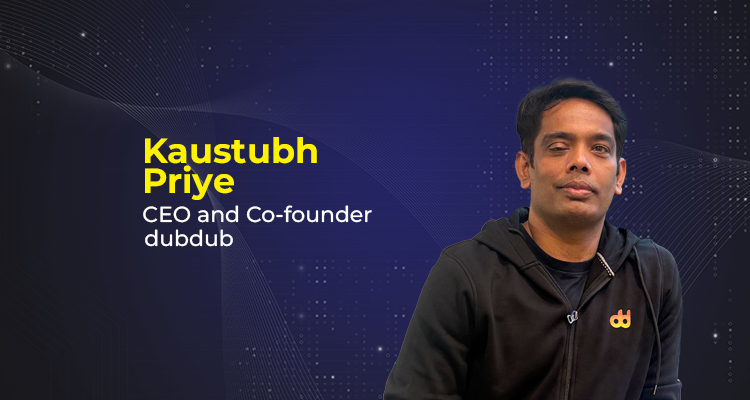
What role does AI play in your business, and how are you translating its potential into practical, real-world applications?
At dubdub, we’re building an infinite, personalised feed of interactive experiences. Imagine the simplicity of scrolling through Instagram, but instead of passively consuming content, you’re solving puzzles, answering trivia, making predictions, and competing with people. To build something like this at scale, you need two things: an enormous supply of engaging content and the ability to match that content to individual users. This is where AI becomes important. We’re building AI-assisted content generation pipelines to create and classify interactive experiences, with validation systems to maintain quality. We are also developing personalisation based on user interests, capabilities, and behaviour. The goal isn’t simply to generate unlimited content. It’s to deliver the right experience, at the right difficulty, to the right person. For us, AI is not the product. It’s the technology that makes an entirely new product experience possible.
How do you differentiate your technology or product from existing solutions in an increasingly competitive market?
We think differentiation starts with understanding what consumer behaviour you’re trying to change. Today, most digital entertainment is either passive content consumption, like Instagram or YouTube, or gaming experiences that require a more deliberate commitment of time and attention. At dubdub, we are trying to bring the best of both worlds together. The simplicity and accessibility of a content feed, but with the active participation and sense of achievement that gaming provides. We believe the recipe for success is a combination of five things: infinite content, great personalisation, micro-moment consumption, calibrated difficulty, and a strong social layer.
Infinite content ensures that users always has something new to discover. Personalisation ensures that what they discover is relevant to their interests. The experience needs to fit naturally into the small, two-to-five-minute moments throughout someone’s day, without requiring a significant time commitment. But relevance alone isn’t enough. Difficulty calibration is equally important. If something is too easy, it becomes boring. If it’s too difficult, it becomes frustrating. We want to continuously find that sweet spot where users feel challenged but also experience frequent moments of achievement. Finally, there’s the social element. Solving something yourself is satisfying, but challenging a friend, competing with others, or seeing how you compare makes the experience much more engaging. We believe these five elements, working together, can turn participation into an everyday habit.
Our differentiation isn’t any one of these features in isolation. It’s building a system where content, personalisation, difficulty, and social engagement continuously reinforce one another. Ultimately, we’re not trying to build another puzzle or trivia app. We’re trying to make participation as effortless and habitual as scrolling.
What were the biggest technical challenges you faced while building and scaling the platform, and how did you overcome them?
Having spent years at Flipkart and Udaan, we have experienced the challenges of scaling large technology platforms. But consumer entertainment presents a different kind of challenge with technology platforms. With dubdub, we are focused on addressing three key challenges: creating high-quality content at scale, delivering meaningful personalisation, and building long-term user engagement.
While AI makes content generation relatively easy, consistently producing accurate, engaging, diverse, and appropriately challenging interactive content is far more complex. We are addressing this through structured generation pipelines, validation, and continuous feedback. At the same time, personalisation goes beyond understanding user interests. Two people may enjoy cricket, but one might prefer challenging statistics while another enjoys simple trivia. Understanding their skill levels, preferences, and intent is essential to delivering relevant experiences.
This is being fixed with structured generation pipelines, validation, and feedback that is given all the time. Personalization, on the other hand, is more than just knowing what users are interested in. Two people may both like cricket, but one might like hard statistics and the other might like easy trivia. To give them meaningful experiences, you need to know their skill levels, preferences, and goals.
Another important is that more activity during a session doesn’t always mean more long-term retention. This has made us focus on making better ways to grow, better ways for people to interact with each other, and more meaningful reasons for people to come back.
The way we do things is based on experiments and facts. We closely look at how users act, test our hypotheses, make changes quickly, and keep improving the experience based on feedback and new information. Scaling a consumer product isn’t just about adding more features to make it work for more people; it’s also about making sure that the experience keeps getting better as the number of users grows.
What technological advancements do you believe will have the greatest impact on your industry over the next three to five years?
Generative AI is dramatically reducing the cost of producing text, images, audio, and video. I believe the same transformation will increasingly extend to interactive experiences. What previously required dedicated creative and production teams could be created at a fraction of the cost. This fundamentally changes the economics of consumer entertainment. Content supply will no longer be the biggest constraint. Quality, relevance, and distribution will become even more important. The second is the ability to build new games and interactive formats much faster. Historically, creating even a relatively simple game required significant engineering, design, and development effort. This limited how many ideas a team could experiment with.
AI is beginning to change that. From writing code and generating visual assets to prototyping game mechanics, the time required to go from an idea to a playable experience is shrinking dramatically. I believe that over the next three to five years, small teams will be able to build and experiment with a variety of interactive formats at a pace that would have been unimaginable a few years ago. For us at dubdub, this is particularly exciting. We don’t want to be restricted to a handful of predefined game formats. We want to continuously experiment with new ways for people to play, solve, compete, and participate. Ultimately, AI will make both content creation and product experimentation dramatically cheaper. The competitive advantage will shift from who can build something to who can figure out what consumers actually love.
As a founder, how do you build and lead a technology team that can innovate while keeping pace with changing market demands?
Having worked at Flipkart, joined Udaan as its fifth engineer, and subsequently built my own startups, I’ve realised that building great technology teams is less about managing engineers and more about creating the right culture. I focus on three principles.
First, ownership over execution. I believe engineers should own problems, not just tasks. When someone understands the problem, the business context, and the expected outcome, they make much better decisions. I don’t want a team that waits for detailed instructions. I want people who question assumptions, take initiative, and feel responsible for the impact of what they build.
Second, talking directly to users. One thing I strongly believe is that everyone building a product, including engineers, should regularly interact with users. Dashboards can tell you what is happening, but conversations often help you understand why. When engineers hear firsthand what frustrates or delights users, their perspective changes. They stop thinking purely about features and start thinking about experiences. Some of the best product insights come from these conversations.
Third, building a culture of experimentation. Especially in consumer technology, nobody has all the answers. What seems like a great idea internally might not work in the real world. I encourage teams to form hypotheses, build quickly, put things in front of users, measure outcomes, and iterate. Failed experiments are acceptable. Spending months building something without validating the underlying assumption is far more expensive.I believe these three principles reinforce each other. Ownership creates accountability, user conversations build empathy, and experimentation helps teams learn continuously. Ultimately, I want to build teams that don’t just ship faster, but learn faster. Because in a rapidly changing market, the speed at which an organisation learns is one of its biggest competitive advantages.
What is your long-term technology roadmap, and how do you see your company contributing to the next phase of industry transformation?
Our long-term ambition is to build the world’s largest platform for interaction, starting with a consumer product that millions of people genuinely enjoy using every day. Also, our focus is on making participation a daily habit. We want to combine engaging content, deep personalisation, adaptive difficulty, and social experiences to make participating as effortless as scrolling.
The next step is building an AI-powered participation engine that can continuously generate content, introduce new interactive formats, and improve the user experience with every interaction. This will help us scale faster while keeping the experience relevant and engaging.
Over time, we see the opportunity extending well beyond entertainment into two areas: interactive advertising and quantitative consumer research. We believe brands will increasingly look for ways to engage consumers through games, quizzes, and challenges rather than traditional advertising. Similarly, by introducing polls and opinion-based formats, we aim to help businesses understand consumer preferences at scale, with the right quality and privacy safeguards in place.
What excites us is that these opportunities are built on the same foundation we’re creating today. Entertainment is our entry point, but participation is the larger opportunity. If we can make millions of people participate every day, dubdub can evolve into a global platform that changes how people engage with content, brands, and businesses.


