
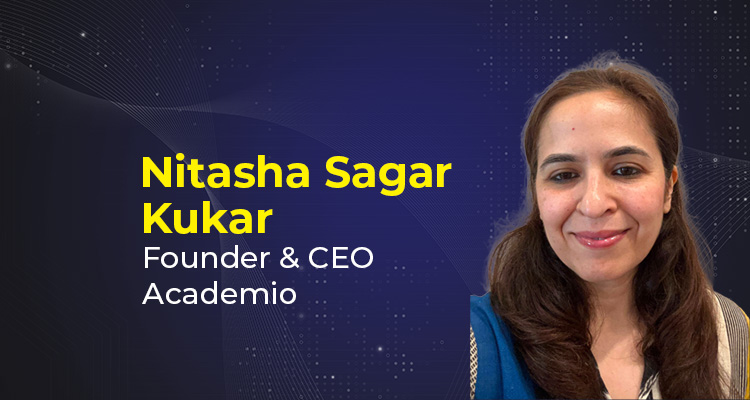
Your journey from leading roles at global organisations to founding an education-focused venture was driven by a personal experience as a parent. What was the defining moment that convinced you there was a significant gap in the international education support ecosystem?
My journey into education entrepreneurship was driven by a challenge I faced as a parent. When my son was in Grade 9, he was studying the IGCSE curriculum and was struggling to move beyond a B grade in History and Economics. One day, he asked if I could help him. As an engineer, I had always been closely involved in his academics, particularly in STEM subjects. We had successfully worked through Mathematics and Science together over the years. However, when it came to subjects such as History, Economics, and English, I quickly realised that success was not simply about understanding the content; it was also about understanding how answers were expected to be structured, analysed, and presented within the curriculum. Having grown up in the CBSE system, this was very different from the way I had been trained to learn and write. What followed was a frustrating search for the right teacher. Over nearly three months, we conducted at least ten trial lessons before finally finding an educator who truly understood the curriculum and could connect with my son’s learning needs. It was a time-consuming and stressful process, especially because academic deadlines do not wait for parents to find the right support. That experience was a turning point for me. I realised that if an educated and resourceful parent like myself found it so difficult to identify quality academic support, countless other families must be facing the same challenge. The issue was not a lack of teachers; it was the absence of a trusted platform that could connect students with the right educators for their specific curriculum, subject, and learning style. That realisation ultimately led to the creation of Academio. Our mission has always been to simplify this journey for families and ensure that students have access to high-quality, curriculum-specific academic support without the uncertainty and frustration that many parents experience today.
Students pursuing IB and Cambridge curricula require a very different approach to learning compared to traditional education systems. In your view, what are the biggest misconceptions parents and students have about succeeding in these programmes?
One of the biggest misconceptions is that success in IB and Cambridge programmes comes primarily from studying harder or spending more hours with textbooks. In reality, these curricula reward understanding over memorisation. Students are expected to analyse, evaluate, apply concepts, and communicate ideas effectively rather than simply reproduce information. Another common misunderstanding is that strong grades alone guarantee success. While academic achievement is important, these programmes also develop research skills, independent thinking, creativity, and intellectual curiosity. Students who learn how to ask meaningful questions often perform better than those who focus solely on obtaining answers. A further misconception is that students can rely on last-minute preparation to achieve strong results. Unlike many traditional examination systems, IB and Cambridge programmes are designed to assess learning over time. Internal assessments, projects, coursework, extended essays, and cumulative understanding all require consistent effort and engagement throughout the academic year. Success is built through steady progress, disciplined study habits, and sustained commitment rather than short bursts of intensive preparation before examinations. Parents sometimes underestimate the importance of academic planning, time management, and emotional well-being. The most successful students are not necessarily the ones who study the longest; they are the ones who develop effective learning habits, maintain balance, and receive guidance that helps them grow as independent learners.
Academio has grown primarily through educator quality and word-of-mouth recommendations. How have you built a model that prioritises academic excellence while scaling a rapidly growing platform?
From the very beginning, we made a conscious decision that quality would never be compromised for growth. Our first priority was building a network of exceptional educators who possessed not only deep subject expertise but also a genuine passion for mentoring and inspiring students.
We place significant emphasis on teaching effectiveness, curriculum knowledge, and student engagement. Equally important is our commitment to listening. We continuously gather feedback from students and parents to ensure that learning outcomes remain at the centre of everything we do. As Academio continues to grow, we will further invest in systems that strengthen quality assurance, educator development, and personalised student experiences. While technology will play an important role in helping us scale and improve efficiency, our core philosophy will remain deeply human. Education is ultimately built on trust, relationships, and meaningful mentorship, and those values will continue to guide every decision we make. The trust families place in us has been our greatest source of growth. A significant proportion of our new students come through referrals from parents and learners who have experienced positive outcomes firsthand. We see this as the strongest validation of our approach. For us, sustainable growth is not a goal in itself; it is the natural result of consistently delivering meaningful academic impact and helping students achieve their full potential.
Technology is transforming education at an unprecedented pace. How do you see AI, personalised learning, and digital mentorship reshaping the future of academic support for students worldwide?
We are entering an era where education can become far more personalised than ever before. AI has the potential to identify learning gaps, adapt content to individual needs, and provide immediate feedback, making learning more efficient and accessible. However, I believe technology works best when it complements, rather than replaces, human educators. While AI can personalise instruction and automate routine tasks, mentorship, motivation, critical thinking, and emotional support remain uniquely human strengths. Students still need experienced educators who can inspire confidence, challenge assumptions, and guide them through complex academic and personal decisions. The future of academic support will likely combine intelligent technology with meaningful human interaction. Students will benefit from personalised learning pathways, global access to expert educators, and continuous support that extends beyond traditional classrooms. This combination has the potential to make high-quality education more accessible and impactful for learners across the world.
You have often advocated for moving beyond rote learning toward conceptual understanding. What changes do you believe schools, educators, and parents need to make to better prepare students for the future?
Schools should create more opportunities for inquiry-based learning, interdisciplinary thinking, and real-world application of knowledge. Educators should focus on helping students understand the “why” behind concepts rather than simply teaching them how to pass examinations. Learning becomes far more meaningful when students can connect ideas across different subjects and contexts.
I am particularly influenced by Barbara Oakley’s work on learning, which highlights the importance of two complementary modes of thinking: the focused mode and the diffuse mode. Focused learning occurs when students actively engage with a problem, practise skills, and work through challenges. Diffuse learning happens when the brain steps back, reflects, and unconsciously forms connections between ideas. Unfortunately, many education systems place excessive emphasis on constant studying and productivity, leaving little room for reflection, creativity, or deep understanding. True learning requires a healthy balance of both.
Parents also play a critical role. Instead of focusing exclusively on grades, they can encourage curiosity, resilience, and independent thinking. Equally important is helping children develop healthy study habits, balanced schedules, and the confidence to explore ideas beyond the syllabus. Asking thoughtful questions can often be more valuable than providing immediate answers.
When schools, educators, and parents work together to cultivate understanding rather than rote performance, students develop not only stronger academic outcomes but also the ability to learn, adapt, and thrive throughout their lives.
As a founder, educator advocate, and parent, what is your long-term vision for Academio, and how do you hope it will impact the next generation of learners?
My long-term vision is for Academio to become a globally trusted learning ecosystem that empowers students to realise their full potential regardless of geography or background. We want to bridge the gap between ambition and opportunity by connecting learners with outstanding educators, mentors, and resources. Beyond academic achievement, our goal is to help students become confident thinkers, effective communicators, and responsible global citizens. We believe education should not simply prepare students for examinations; it should prepare them for life. As a parent, I understand the hopes families have for their children. As a founder, I believe we have a responsibility to create learning experiences that inspire growth, curiosity, and confidence. If Academio can help students discover their strengths, develop a love for learning, and pursue their aspirations with courage, then we will have achieved something truly meaningful for the next generation.
Enjoyed this interview? Now imagine yours. Write to:
jeevika@thefoundermedia.in