
Inside the glass tower of a Fortune 500 tech firm, a quarterly strategy review is underway. Millions of dollars are allocated to a sleek rebrand: a refined logo, an emotional television campaign, and an aggressive performance-marketing budget designed to win customer hearts and market share.
Yet, three floors down, the talent acquisition team is quietly haemorrhaging top candidates. Key positions sit open for 90 days. Offer acceptance rates are plunging, and Glassdoor reviews describe a culture adrift.
This scenario plays out daily across corporate America, Europe, and emerging global markets. Organisations spend fortunes telling the world what they sell, while entirely ignoring who they are to the people who build, sell, and support it. Employer branding—the intentional curation of a company’s reputation as a workplace—remains one of the most vital, yet consistently overlooked, levers of modern enterprise value.
The fatal misunderstanding: Brand vs. Perks
The core reason employer branding is so regularly neglected lies in a fundamental misunderstanding of what it actually is.
For decades, leadership teams have conflated “employer brand” with surface-level perks. Cold-brew taps, ping-pong tables, catered lunches, and glossy recruitment brochures were treated as a proxy for culture. When budget cuts arrived, these initiatives were the first to be slashed, framed as non-essential fluff.
However, genuine employer branding is not a perk package; it is the authentic Employer Value Proposition (EVP)—the unwritten contract between what an organisation expects from its people and what it offers in return. It encompasses leadership integrity, psychological safety, career architecture, autonomy, and purpose.
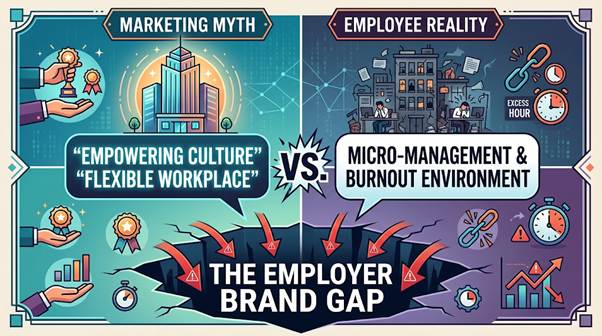
When companies reduce employer branding to a marketing gimmick, candidates see right through it. In an age of unprecedented workplace transparency, where platforms like Glassdoor, LinkedIn, and Reddit offer unfiltered window-views into company culture, a disconnect between the glossy career site and actual day-to-day reality is disastrous.
The hidden cost of neglect
Why does this oversight persist? Primarily because traditional accounting does not feature a line item for “Brand Decay in Talent Markets.” Yet the financial penalties of ignoring your employer brand are staggering.
- The Talent Premium: Research consistently shows that companies with poor reputations must pay a “talent tax”—often offering 10 per cent to 20 per cent higher salaries to convince candidate to join a compromised culture.
- Cost-per-Hire Escalation: When a brand fails to attract organic inbound interest, talent acquisition teams rely heavily on external recruiters, paid placements, and aggressive outbound sourcing, driving cost-per-hire through the roof.
- Retention Leaks: A misleading employer brand creates a mismatch between candidate expectations and workplace reality. This directly fuels early turnover—employees quitting within their first 90 to 180 days—forcing the organisation into an expensive cycle of backfilling.
When a consumer brand fails, product sales slump. When an employer brand fails, the organization’s capacity to execute its entire business strategy shrinks. Innovation slows, operational friction increases, and customer-facing quality drops.
“Candidates no longer buy what you say you are; they buy what your current and former employees say you are when the management team leaves the room.”
The ownership dilemma: Nobody’s job, everybody’s problem
Another reason employer branding remains neglected is an internal tug-of-war over ownership.
Where does employer brand live?
- Human Resources often views it as a transactional recruiting tool, focusing on job postings and applicant tracking systems rather than narrative-building.
- Corporate Marketing prioritises consumer revenue, treating talent initiatives as a secondary distraction.
- The C-Suite views it as a soft HR responsibility, failing to connect employee sentiment with market valuation and shareholder returns.
Because employer branding sits squarely at the intersection of culture, marketing, and strategy, it frequently drops into the cracks between departments. Without explicit C-suite backing and dedicated cross-functional resources, it devolves into sporadic, reactive campaigns triggered only when hiring spikes or crisis strikes.
The transparency paradigm shift
Historically, executive teams could control their employer narrative through press releases and orchestrated executive profiles. That era is over.
Today’s workforce evaluates prospective employers with the same rigor consumers use when booking a hotel. Candidates cross-reference leadership claims against real employee sentiment, modern workplace flexibility standards, and corporate governance practices.
When a company experiences a lay-off, a culture pivot, or a shift in policy, the market learns about it in real time. Organisations that proactively build a resilient, honest employer brand create a cushion of trust. Those that ignore it find themselves exposed at the first sign of friction.
Reclaiming the narrative: How leaders must adapt
For organizations ready to treat employer brand as a strategic asset rather than an HR afterthought, the path forward requires a fundamental mindset shift.
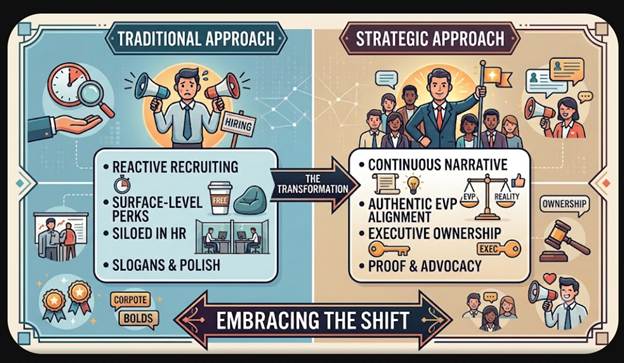
- Elevate Ownership to the C-Suite: Employer branding must be treated as a core component of overall corporate strategy, co-owned by the Chief HR Officer, Chief Marketing Officer, and Chief Executive Officer.
- Align Internal Reality with External Narrative: An employer brand cannot fix a toxic culture; it can only reflect a healthy one. Organisations must invest in employee experience (EX) before crafting talent campaigns.
- Turn Employees into Brand Advocates: Modern candidates trust peers far more than corporate copy. Empowering employees to share authentic stories, project outcomes, and day-to-day experiences on social platforms is exponentially more powerful than any sponsored recruitment ad.
- Measure Employer Brand as Enterprise Value: Track metrics like inbound candidate quality, offer acceptance rates, time-to-fill, employee net promoter scores (eNPS), and early turnover rates to demonstrate ROI directly to board members.
The bottom line
In a knowledge-driven economy, every enterprise advantage—product design, customer service, technological innovation, and operational agility—stems directly from talent.
Companies do not build products; people do. Ignoring the employer brand means ignoring the single mechanism that brings high-calibre talent through the door. The organizations that win the coming decade will not just be those with the best consumer messaging, but those that treat their workplace identity with the exact same strategic discipline, investment, and rigor.