
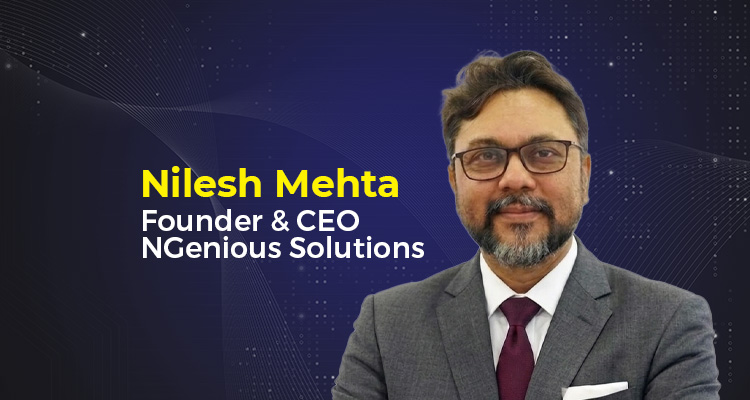
Why is process automation not just an IT initiative but a business transformation initiative, and how does NGenious’s positioning reflect that?
Process automation is often misunderstood as a technology exercise. In reality, it is a business design exercise. Technology may execute the workflow, but the real question is: what decision, delay, dependency, or control gap are we trying to improve?
When automation is approached only by IT, companies usually digitize existing inefficiencies. A manual approval becomes a digital approval, but the process remains slow. True automation requires business teams to rethink how work should move across finance, operations, HR, sales, service, compliance, and leadership.
At NGenious Solutions, we look at automation through that wider lens. Our work spans business applications, enterprise workflows, AI, data, cloud, and service management. This allows us to connect process, platform, and business outcome. The goal is not automation for its own sake. The goal is better visibility, faster execution, stronger governance, and more time for people to focus on judgment-led work.
Among the industries NGenious serves, which do you think has the most complex compliance requirements, and what does that complexity demand from an implementation partner?
Banking, financial services, healthcare, and pharmaceuticals are all highly compliance-driven. However, BFSI is especially complex because it combines customer data, transactions, auditability, risk, cybersecurity, approvals, regulatory reporting, and service accountability in one environment.
This complexity demands more than technical implementation. A partner must understand how controls are built into workflows. Access rights, maker-checker approvals, audit trails, data retention, exception handling, and reporting cannot be afterthoughts. They must be part of the solution design.
For instance, automating KYC, credit approvals, vendor onboarding, or customer service workflows is not just about reducing turnaround time. It is also about ensuring that every step is traceable, secure, and compliant. In such sectors, speed without control can create risk. The right implementation partner must therefore balance agility with governance.
Business Central is NGenious’s ERP offering. How does Business Central differ from the full Dynamics 365 Finance & Operations suite, and when would you recommend one over the other to a client?
Business Central is well-suited for small and mid-sized businesses that need an integrated ERP for finance, purchase, sales, inventory, projects, services, and core operations. It is particularly useful for organizations moving from spreadsheets, entry-level accounting tools, or legacy ERP systems to a modern cloud-based platform.
The broader Dynamics 365 enterprise ERP landscape, including Dynamics 365 Finance and Dynamics 365 Supply Chain Management, is better suited for larger enterprises with more complex global operations, multi-entity structures, advanced manufacturing, supply chain depth, tax complexity, and enterprise-grade governance requirements.
We recommend Business Central when the client needs speed, usability, standardization, and faster adoption without over-engineering the system. We recommend the larger Dynamics 365 enterprise applications when the business model itself demands deeper operational complexity. The right ERP choice should not be based on company size alone. It should be based on process maturity, scale, complexity, and future growth plans.
How do you handle cloud cost optimization for clients who are overspending on Azure or AWS resources?
Cloud cost optimization begins with visibility. Many organizations do not overspend because they are careless. They overspend because cloud consumption grows faster than governance. Teams create resources, test environments remain active, workloads are oversized, storage tiers are not reviewed, and ownership becomes unclear.
Our approach starts with a detailed assessment of usage, idle resources, compute sizing, storage, licensing, tagging, subscriptions, and workload patterns. From there, we identify practical actions such as rightsizing, shutting down unused resources, using reserved or committed capacity where appropriate, applying autoscaling, improving monitoring, and setting budget alerts.
However, cost optimization should not be treated as a one-time cleanup. It needs an operating rhythm. Finance, IT, and business teams must regularly review cloud spend against usage and value. The objective is not simply to reduce the bill. It is to make cloud investment more predictable, accountable, and aligned with business priorities.
NGenious offers OpenAI and ServiceNow AI solutions. How have you integrated OpenAI APIs into enterprise applications and what guardrails did you put in place?
We see the strongest value from OpenAI APIs when they are embedded into real enterprise workflows rather than used as standalone experiments. Use cases can include document intelligence, knowledge search, ticket summarization, automated response drafting, contract or policy interpretation, and workflow assistance.
The guardrails are critical. We first define the approved use case and business boundary. Then we control the data sources, apply role-based access, reduce unnecessary exposure of sensitive information, and keep human review in place for high-impact decisions. We also use prompt controls, validation, logging, testing, and output review mechanisms.
In enterprise AI, the important question is not only whether the system can generate an answer. The more important question is whether that answer is appropriate, secure, explainable, and usable in that specific business context. AI adoption will scale only when trust and governance scale with it.
How do you approach integration between a custom application and an existing ERP like Dynamics 365 or Business Central?
We begin with the business process before discussing the technical connector. The first questions are: what data needs to move, which system owns it, how frequently should it sync, who depends on it, and what happens if something fails?
Once that is clear, we define the integration architecture. Depending on the need, this may involve standard APIs, web services, middleware, Power Platform, scheduled synchronization, event-based integration, or custom connectors. With ERP systems such as Dynamics 365 or Business Central, it is important to preserve the ERP as the system of record and avoid creating duplicate logic outside the core platform.
A good integration should not merely transfer data. It should be secure, auditable, monitored, documented, and supportable. Businesses change, and integrations must be built with that reality in mind. The real test of integration is not whether it works on day one. It is whether it continues to work reliably as the organization grows.
Enjoyed this interview? Now imagine yours. Write to:
editor@thefoundermedia.com