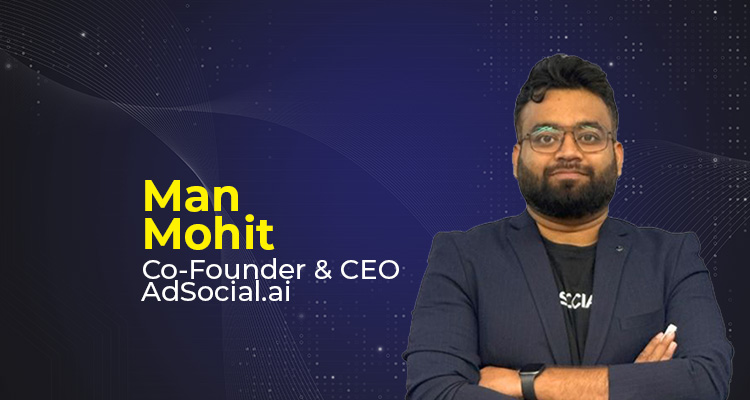
AdSocial.ai positions itself as a Visual Personalisation Operating System. What architectural principles differentiate an “OS” from a traditional personalisation or creative optimisation tool?
AdSocial.ai positions itself as a Visual Personalisation Operating System because it replaces manual, human-driven decision-making with a system-level intelligence layer.
Today, personalisation is limited by how many segments teams can manually define and how many variations humans can create, which caps the depth and scale of personalisation.
Traditional tools only help execute decisions that teams already make, what segment to target, what experience to show, and where to run it.
AdSocial.ai introduces a central decision layer that continuously generates audiences, decides what experience each audience should see, creates variations at scale, and learns from performance in real time. Instead of optimising isolated campaigns, it orchestrates personalisation across journeys, removing human bottlenecks and enabling personalisation that scales combinatorially rather than linearly. This system-level control and closed-loop learning is what fundamentally makes it an OS, not a tool.
What are the biggest blockers enterprises face when moving from rule-based to AI-led personalization?
The biggest blockers enterprises face when moving from rule-based to AI-led personalisation are organisational and trust-related, not technological. Manual decision ownership is deeply embedded; teams are used to defining segments, rules, and creatives themselves, so shifting control to AI disrupts existing workflows, approval chains, and role boundaries. At the same time, enterprises need strong guardrails around brand safety, compliance, creative constraints, and explainability; when AI operates as a black box, trust breaks and scale stalls.
This is exactly where AdSocial.ai is designed differently. It sits inside enterprise workflows, not outside them, preserving human control while removing manual bottlenecks. Teams define the guardrails, and the system handles scale, variation, and continuous learning, enabling a confident shift from rule-based to AI-led personalisation.
How do you ensure explainability for enterprise teams who need to justify personalisation decisions internally?
A small portion of customers is always kept in a control setup, deliberately not exposed to personalisation. This creates a long-term behavioural baseline that allows teams to clearly isolate the true impact of every personalisation decision. Every decision in AdSocial.ai is traceable across three dimensions: what changed, what it delivered, and why it changed, with the “why” powered by a contextual graph that captures audience signals and intent. Teams can drill this down at a segment level to see which signal triggered a change, which visual or creative variation was selected within approved guardrails, and how that experience performed against the control baseline. By grounding explainability in performance deltas and revenue impact, and embedding this directly into existing workflows, enterprises can confidently justify personalisation decisions internally.
How do you decide which capabilities belong in the core OS versus integrations or plugins?
We decide this based on where decisions must be centralised versus where execution should remain modular. Anything that determines user intent, journey structure, and experience decisions lives in the core OS; anything that simply renders, serves, or delivers those decisions remains an integration or plugin. AdSocial.ai sits above the data warehouse and connects to all downstream serving systems, CMS powering landing pages, offer engines, search and relevance systems, product catalogs, and communication channels like CleverTap, MoEngage, or in-house tools.
The core OS is responsible for deciding which journey a user should experience, what should be shown at each moment, where it should appear, and when it should be delivered, based on unified user data and context. These decisions are then orchestrated directly to downstream systems for execution. Feedback from every touchpoint flows back into the OS, allowing parameters to be continuously optimized. This separation ensures that intelligence and learning stay centralised, while execution remains flexible, replaceable, and scalable.
What advice would you give to product leaders trying to move from experimentation-driven AI to production-grade systems?
My advice to product leaders is to stop treating AI personalisation as a series of isolated experiments and start designing it as a production system. Experimentation is necessary, but if your system isn’t continuously learning and building long-term context about users, it will never reach optimal outcomes. The biggest shift required is the unification of decision-making. When decisions are split across channels, tools, and teams, the customer journey can never be truly personalised, only locally optimised.
Production-grade AI requires systems that have full context across touchpoints and can use that context to make better decisions in real time. Equally important is execution at scale: it’s not enough for a model to decide what should happen if the system can’t reliably deliver that decision across channels and iterate based on feedback. Product leaders should invest in architectures where intelligence is centralised, context compounds over time, and execution scales automatically. This is what turns experimentation-driven AI into durable, production-grade personalisation.
Enjoyed this interview? Now imagine yours. Write to:
editor@thefoundermedia.com